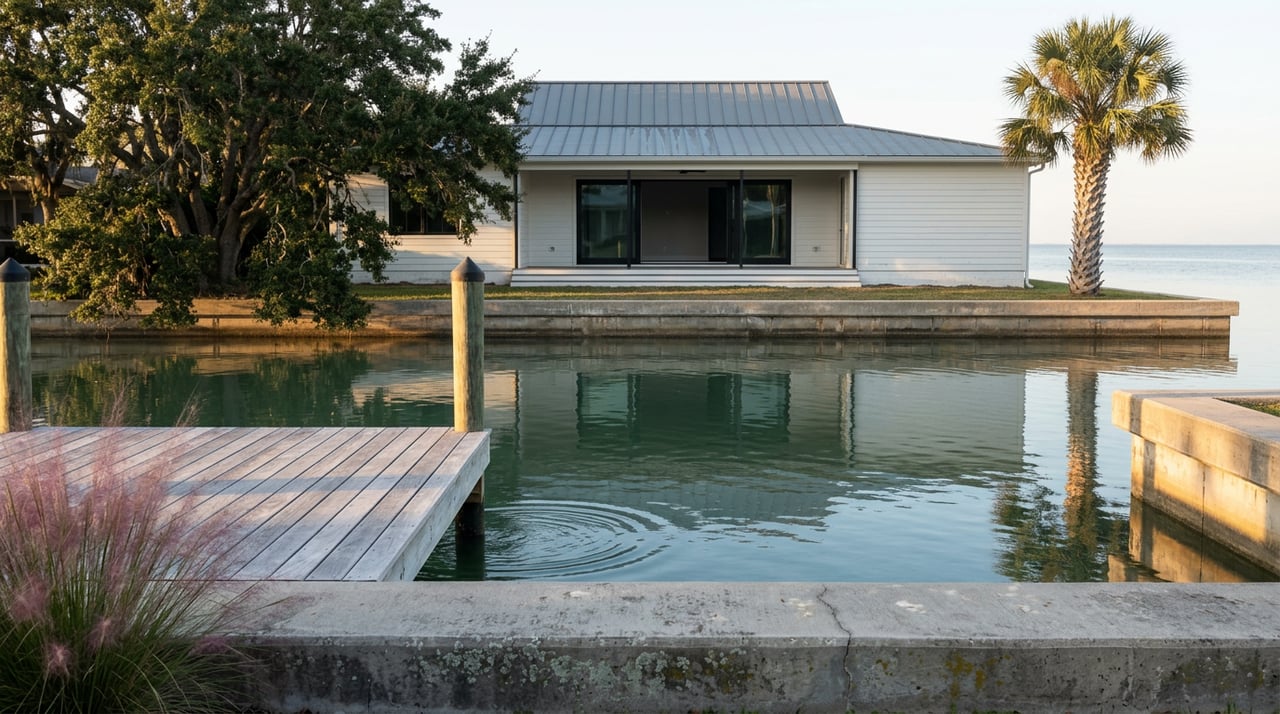
What actually happens when the thing holding your yard in place starts to fail three weeks before closing?
That question rarely comes up during a showing. Buyers walk the dock, check the sunset angle, and ask about boat lift weight ratings. Sellers price the view. Almost nobody asks about the wall standing between the water and the yard, until an inspector does, and by then the clock on the deal is already running.
Fort Walton Beach sits on a narrow strip of land between two very different bodies of water, and both of them are hard on concrete. That geography, combined with a two-agency permit process that doesn't move at the speed of a standard 30-to-45-day closing, is the part of a waterfront transaction that catches people off guard here more than almost anything else.
The Timeline Problem, Not Just the Price Problem
Most buyers think about a seawall the way they think about a roof: a line item, a number, a repair estimate to negotiate against. That's the easy part. The harder part is that, according to seawallrepairs.com, structural seawall repair in Fort Walton Beach requires sign-off from two separate authorities, not one. Okaloosa County has to issue a building permit, and the Florida Department of Environmental Protection's Northwest District has to review the work as well. Near Okaloosa Island and the Choctawhatchee Bay passes, coastal construction setback rules add a third layer.
That matters because permitting can affect the deal timeline. If an inspection turns up a compromised wall during a 30-day due diligence period, the buyer and seller aren't just negotiating a price adjustment. They're negotiating around a repair that can't legally start, let alone finish, before closing. On a listing that already has a full-price offer sitting on the table, that's the difference between a clean close and a deal that drags into a second or third amendment.
Two Bodies of Water, Two Ways to Fail
Part of what makes this tricky is that Fort Walton Beach waterfront doesn't fail for one reason. The city sits between Santa Rosa Sound and Choctawhatchee Bay, and each one stresses a seawall differently.
Santa Rosa Sound is relatively protected, so wave height isn't the main threat. The problem there is boat wake, concentrated by heavy Intracoastal Waterway traffic hitting the same stretch of wall day after day. Choctawhatchee Bay is the opposite kind of problem. It stretches 27 miles east to west, which gives wind enough room to build real waves during frontal systems, especially in fall and winter. And where the two meet at the Okaloosa Island pass system, strong tidal currents scour the base of seawalls on both sides.
| Water body | Primary stress on the wall |
|---|---|
| Santa Rosa Sound | Boat wake from Intracoastal traffic |
| Choctawhatchee Bay | Wind-driven waves from long fetch |
| Okaloosa Island pass | Tidal current scour on both sides |
A wall that's held up fine for twenty years on the Sound side of a property isn't necessarily built for what a Bay-facing lot deals with, and vice versa. That's worth knowing before assuming a neighbor's clean seawall history says anything about the lot next door.
What the Repair Actually Costs
When a seawall does need work, the range is wide enough that guessing is a bad idea. Seawall repair along Santa Rosa Sound or Choctawhatchee Bay typically runs $155 to $510 per linear foot, depending on the extent of the damage and the repair method.
That range can add up quickly against a listing price. The final bill depends on the wall's length, the extent of the damage, and the repair method, and it's exactly the kind of number that shows up in an inspection report and immediately reopens price negotiations that both sides thought were settled.
The Maintenance Clock Sellers Ignore
Seawalls don't fail on a schedule, but the industry recommendation for this area is consistent: annual inspection for waterfront properties on Santa Rosa Sound and Choctawhatchee Bay, with a follow-up inspection after any named storm. That second part matters here specifically, given how many systems pass close enough to the Panhandle each hurricane season to put stress on a wall even without a direct hit.
The age of the wall is its own signal. In canal communities near Fort Walton Beach, like Cinco Bayou, seawalls built during the area's main development push are now 30 to 50 years old. A lot of Fort Walton Beach's own canal and bayfront inventory was built in that same era, which means a meaningful share of the waterfront housing stock on the market right now is old enough for tiebacks and drainage systems to be reaching the end of their useful life, even if the concrete cap still looks fine from the yard.
What This Means If You're Selling
If you're listing a waterfront home in Fort Walton Beach, the seawall is worth getting ahead of before a buyer's inspector finds it for you. An inspection before you list does two things. It tells you whether you're pricing against a known cost or an unknown one, and it gives you documentation to hand a buyer's agent instead of a verbal assurance that "it's never been a problem."
If the wall has been repaired or replaced at some point, pull the permit history now, not during the buyer's due diligence window. Permit-history questions are easier to sort out on your own timeline than under contract with a closing date attached.
If you want a sense of where your property sits relative to current waterfront demand before you make any of these calls, a home valuation is a reasonable place to start that conversation.
What This Means If You're Buying
For buyers, treat the seawall like you'd treat a roof or an HVAC system, not like a scenic backdrop. Ask directly whether the wall, dock, and boat lift were permitted, and ask to see the paperwork rather than taking a verbal yes. Unpermitted structures don't disappear at closing.
Get a real insurance quote during your due diligence period, not after you're already under contract.
And remember which side of the property you're buying into. A Fort Walton Beach lot on Santa Rosa Sound and one on Choctawhatchee Bay are dealing with different physics on the same wall material, so a clean inspection on one doesn't tell you much about the other.
A Few Questions Worth Asking Before You Sign
How often should a seawall on Santa Rosa Sound or Choctawhatchee Bay be inspected? Annually, at minimum, with an additional inspection after any named storm that comes close enough to the coast to put stress on the structure.
Do small patch repairs need the same permits as a full rebuild? Structural work requires both an Okaloosa County building permit and Florida DEP Northwest District review. Confirming with the county before work starts is the only way to know for certain, and it protects your closing timeline either way.
The view is real. So is the wall holding it in place. Knowing which one you're actually negotiating over is what keeps a Fort Walton Beach waterfront deal on schedule.
If you're weighing a purchase or a sale on the water here and want a straight read on what a specific seawall, dock, or permit history means for your timeline, Olivia A Wolff Pllc is a good next call. Let's Connect.
This article is general information, not legal, tax or financial advice. Consult a qualified professional about your situation.